



 English
 简体中文
简体中文 繁體中文
繁體中文 ไทย
ไทย ខ្មែរ
ខ្មែរ ဗမာ
ဗမာ Indonesia
 Tiếng Việt
 Русский
 Deutsch
 Español
 Français

การเป็นเจ้าของคาสิโนแบบไวท์เลเบล กับการเป็นตัวแทนในเอเชีย: ข้อแลกเปลี่ยนทางธุรกิจที่แท้จริง
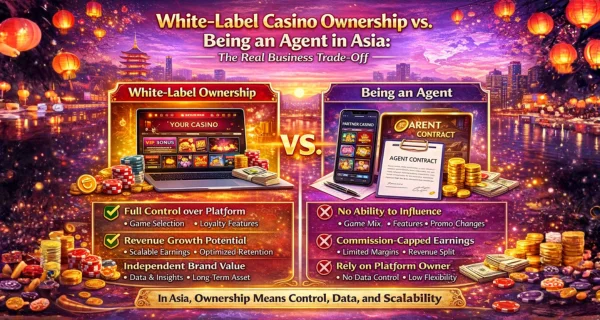
ในตลาดคาสิโนออนไลน์ที่มุ่งเน้นตลาดเอเชีย ผู้ประกอบการหน้าใหม่จำนวนมากเข้าสู่อุตสาหกรรมในฐานะตัวแทน รูปแบบดูเหมือนจะง่าย: โปรโมตแพลตฟอร์มที่มีอยู่ รับค่าคอมมิชชั่น และหลีกเลี่ยงความซับซ้อนในการดำเนินงาน
อย่างไรก็ตาม เมื่อตลาดเติบโตเต็มที่และการแข่งขันทวีความรุนแรงขึ้น ผู้ประกอบการจึงต้องเผชิญกับการตัดสินใจเชิงกลยุทธ์มากขึ้นเรื่อยๆ:
ดำเนินการเป็นตัวแทนต่อไป หรือเปลี่ยนไปเป็นเจ้าของคาสิโนแบบไวท์เลเบล
ความแตกต่างระหว่างทั้งสองอย่างไม่ได้อยู่ที่โครงสร้างเพียงอย่างเดียว แต่ยังเปลี่ยนแปลงการควบคุม ความสามารถในการขยายขนาด และมูลค่าทางธุรกิจในระยะยาวอย่างพื้นฐานด้วย
เหตุใดโมเดลตัวแทน จึงมักจะเป็นจุดเริ่มต้น
รูปแบบตัวแทนยังคงได้รับความนิยมเนื่องจากช่วยลดอุปสรรคในการเริ่มต้นเข้าสู่ตลาด
โดยทั่วไปแล้ว ตัวแทนจะ:
- เน้นการดึงดูดผู้เล่นและสร้างเครือข่าย
- ดำเนินการโดยปราศจากความรับผิดชอบทางเทคนิคหรือผลิตภัณฑ์
- รับค่าคอมมิชชั่นตามยอดขายหรือผลกำไรสุทธิ
- ขึ้นอยู่กับการตัดสินใจของเจ้าของแพลตฟอร์มโดยสิ้นเชิง
สำหรับผู้ประกอบการในระยะเริ่มต้น วิธีนี้อาจเป็นวิธีที่มีประสิทธิภาพในการทำความเข้าใจพฤติกรรมการจราจรและความชอบของผู้เล่นโดยมีความเสี่ยงน้อยที่สุด
ข้อจำกัดนี้จะไม่ปรากฏให้เห็นตั้งแต่เริ่มต้น แต่จะค่อยๆ ชัดเจนขึ้นเมื่อธุรกิจเติบโตขึ้น
จุดเริ่มต้นของโมเดลตัวแทน เริ่มล้มเหลว
As traffic increases, many agents encounter the same constraints:
- No control over product direction
Agents cannot influence:
- Game mix
- Feature launches
- Lobby structure
- Promotion mechanics
- Platform UX changes
Performance is tied to decisions made elsewhere.
- Earnings are capped by structure
Commission-based income scales linearly. Even with strong growth, margins are limited by preset rules, revenue splits, and external adjustments.
- No long-term asset is created
An agent builds traffic — not a platform, not a brand, and not a transferable business asset.
If the relationship ends, the value often disappears overnight.
What changes with white-label ownership
White-label ownership shifts an operator from distribution to control.
Instead of promoting someone else’s platform, the operator runs their own branded casino with full authority over strategy and execution.
Key structural differences include:
- Full control over product and roadmap
White-label owners decide:
- Which games are featured
- How lobbies are structured
- How mechanics are introduced
- How player journeys are designed
This allows optimisation based on real player data rather than external priorities.
- Revenue scales with the business
Instead of fixed commissions, revenue becomes a function of:
- Player retention
- Game performance
- Portfolio optimisation
- Operational efficiency
This unlocks compounding growth rather than capped returns.
- The business becomes an asset
A white-label casino is:
- Brand-driven
- Data-backed
- Transferable
- Expandable
It can be grown, restructured, or integrated into larger strategies — something an agent model does not allow.
Why this distinction matters more in Asia
Asian-facing markets evolve quickly. Player preferences shift, mechanics trend cycles are shorter, and competition is intense.
In this environment:
- Speed of iteration matters
- Local optimisation matters
- Control over content and experience matters
Operators who remain agents often struggle to adapt fast enough, while white-label owners can reposition their platforms, game mix, and branding without external dependency.
The hidden cost of staying an agent too long
Many operators delay transitioning because the agent model feels “safer.”
In reality, the hidden cost is opportunity loss:
- Missed brand equity
- Limited data ownership
- Inability to differentiate
- Dependence on third-party decisions
Over time, this gap compounds.
Choosing the right time to transition
White-label ownership is not about abandoning the agent model immediately. For many operators, the optimal path is:
- Learn the market as an agent
- Build traffic and operational knowledge
- Transition to ownership once scale and confidence exist
The key is recognising when growth is being limited by structure rather than capability.
Key takeaway
Being an agent is a distribution role.
Owning a white-label casino is a business strategy.
In Asian-facing markets, operators who aim for long-term scale, flexibility, and enterprise value eventually move beyond commission-based models and into ownership — where control, data, and growth align.