



 English
 简体中文
简体中文 繁體中文
繁體中文 ไทย
ไทย ខ្មែរ
ខ្មែរ ဗမာ
ဗမာ Indonesia
 Tiếng Việt
 Русский
 Deutsch
 Español
 Français

White-Label Casino Ownership vs Being an Agent in Asia: The Real Business Trade-Off
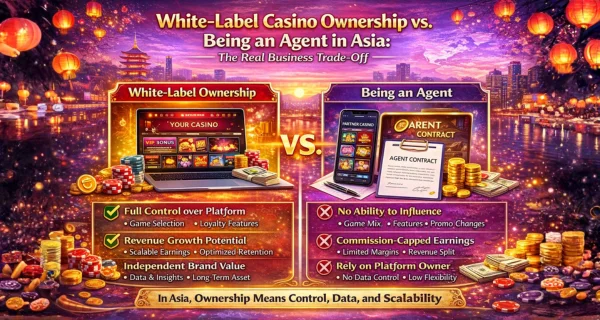
In Asian-facing online casino markets, many newcomers enter the industry as agents. The model appears simple: promote an existing platform, earn commissions, and avoid operational complexity.
However, as markets mature and competition intensifies, operators increasingly face a strategic decision:
Continue as an agent — or transition into white-label casino ownership.
The difference between the two is not just structural. It fundamentally changes control, scalability, and long-term business value.
Why the agent model is often the entry point
The agent model remains popular because it lowers the initial barrier to entry.
Agents typically:
- Focus on player acquisition and network building
- Operate without technical or product responsibility
- Earn commission based on turnover or net results
- Rely entirely on the platform owner’s decisions
For early-stage operators, this can be an effective way to understand traffic behaviour and player preferences with minimal risk.
The limitation is not visible at the start — it emerges as the business grows.
Where the agent model starts to break down
As traffic increases, many agents encounter the same constraints:
- No control over product direction
Agents cannot influence:
- Game mix
- Feature launches
- Lobby structure
- Promotion mechanics
- Platform UX changes
Performance is tied to decisions made elsewhere.
- Earnings are capped by structure
Commission-based income scales linearly. Even with strong growth, margins are limited by preset rules, revenue splits, and external adjustments.
- No long-term asset is created
An agent builds traffic — not a platform, not a brand, and not a transferable business asset.
If the relationship ends, the value often disappears overnight.
What changes with white-label ownership
White-label ownership shifts an operator from distribution to control.
Instead of promoting someone else’s platform, the operator runs their own branded casino with full authority over strategy and execution.
Key structural differences include:
- Full control over product and roadmap
White-label owners decide:
- Which games are featured
- How lobbies are structured
- How mechanics are introduced
- How player journeys are designed
This allows optimisation based on real player data rather than external priorities.
- Revenue scales with the business
Instead of fixed commissions, revenue becomes a function of:
- Player retention
- Game performance
- Portfolio optimisation
- Operational efficiency
This unlocks compounding growth rather than capped returns.
- The business becomes an asset
A white-label casino is:
- Brand-driven
- Data-backed
- Transferable
- Expandable
It can be grown, restructured, or integrated into larger strategies — something an agent model does not allow.
Why this distinction matters more in Asia
Asian-facing markets evolve quickly. Player preferences shift, mechanics trend cycles are shorter, and competition is intense.
In this environment:
- Speed of iteration matters
- Local optimisation matters
- Control over content and experience matters
Operators who remain agents often struggle to adapt fast enough, while white-label owners can reposition their platforms, game mix, and branding without external dependency.
The hidden cost of staying an agent too long
Many operators delay transitioning because the agent model feels “safer.”
In reality, the hidden cost is opportunity loss:
- Missed brand equity
- Limited data ownership
- Inability to differentiate
- Dependence on third-party decisions
Over time, this gap compounds.
Choosing the right time to transition
White-label ownership is not about abandoning the agent model immediately. For many operators, the optimal path is:
- Learn the market as an agent
- Build traffic and operational knowledge
- Transition to ownership once scale and confidence exist
The key is recognising when growth is being limited by structure rather than capability.
Key takeaway
Being an agent is a distribution role.
Owning a white-label casino is a business strategy.
In Asian-facing markets, operators who aim for long-term scale, flexibility, and enterprise value eventually move beyond commission-based models and into ownership — where control, data, and growth align.